What Is Spatial Reality and How It Works
Spatial reality is a way of computing that places digital content in relation to your physical surroundings, so apps and media can feel anchored in space instead of trapped inside a flat screen.
What is spatial reality? Spatial reality is becoming a bigger part of the conversation around immersive technology because it describes something broader than a simple screen experience. Instead of forcing digital content to live only on a phone, laptop, or television, spatial reality treats the physical world as part of the interface.
That matters because people do not naturally think in flat windows. We move through rooms, judge distance, notice surfaces, and interact with objects in three dimensions. Spatial reality tries to make digital experiences work more like the world around us, using space itself as part of the system. If you are comparing similar terms, this also helps clarify the difference between VR, AR, and MR. It also helps to understand what spatial computing is, because spatial reality is one practical expression of that broader idea.
This topic becomes easier to place once you understand what virtual reality is and how haptic feedback in VR adds another layer of immersion beyond visuals alone.
For broader context, review Apple’s visionOS documentation, Microsoft’s mixed reality documentation, and Meta’s metaverse and spatial platform overview.
What Does Spatial Reality Mean?
Spatial reality refers to digital experiences that understand and respond to physical space. In practical terms, that means software can place content around you, recognize surfaces, react to movement, and present information in ways that feel aware of your environment.
The phrase is often connected to spatial computing, mixed reality, and advanced immersive interfaces. Depending on the product, spatial reality may include virtual objects layered into real rooms, large floating screens pinned in space, or interactive environments that blend physical context with digital content.
How Does Spatial Reality Work?
Spatial reality depends on hardware and software working together. Cameras, depth sensors, motion tracking, and environmental mapping help the system understand your surroundings. The software then uses that information to place and stabilize digital content so it feels anchored in a believable location.
For example, a device may identify a wall, table, or floor and use that as a reference point for virtual content. It can also track your head and hand movement so digital objects stay in the right place as you move. This is what helps experiences feel consistent rather than floating randomly or drifting out of alignment.
The quality of the experience depends on accurate tracking, low latency, strong displays, and software that understands scale and depth. When those elements work well together, digital interfaces can feel much more natural and useful in physical space.
Key Parts of a Spatial Reality System
1. Sensing and Understanding Physical Space
Spatial reality starts with awareness of the physical environment. Devices need to detect surfaces, boundaries, depth, and sometimes objects in the room. Without this foundation, digital content cannot behave reliably in a real space.
Why It Matters
- Lets digital content anchor to walls, tables, and open space
- Improves realism and stability
- Supports safer and more useful interaction
Limits
- Performance depends on sensor quality and lighting conditions
- Poor mapping can reduce comfort and believability
2. Tracking Movement, Hands, and Gaze
Once the system understands the room, it also needs to understand you. Head tracking keeps content stable as you move. Hand tracking, controllers, or gaze input let you select, resize, move, and interact with spatial interfaces.
Why It Matters
- Makes interfaces feel responsive and intentional
- Supports more natural interaction than flat touch input
- Helps turn space into a usable interface
Limits
- Input systems can still feel less precise than a mouse or keyboard
- Long sessions depend on comfort and tracking accuracy
3. Apps, Media, and Workflows Built for Space
Spatial reality becomes useful when software is designed around real spaces instead of simply copying desktop windows. That can include collaboration tools, immersive media viewers, design walkthroughs, educational simulations, or productivity apps that use spatial placement to organize information.
Why It Matters
- Unlocks experiences that are difficult on flat screens
- Can improve context, scale, and presence
- Opens new approaches for entertainment and work
Limits
- Not every app benefits from spatial interaction
- Good spatial design is harder than simply porting a 2D interface
Common Uses of Spatial Reality
Spatial reality can be useful in entertainment, design, training, communication, and productivity. In media, it can create large immersive displays or place content naturally around a room. In professional work, it can help teams review 3D models, collaborate in shared space, or visualize layouts before real construction begins.
Education and training can also benefit because spatial systems can present objects, simulations, and instructions in ways that are easier to understand through position and scale. Retail, healthcare, architecture, and remote collaboration are all areas where spatial interfaces may add practical value if the software is designed well.
Haptic feedback can strengthen these systems when tactile experience supports what users see in space. That added tactile layer can improve immersion in training and design tools by making digital interactions feel more grounded instead of purely visual.
It is important to remember that spatial reality is not automatically better for every task. It works best when location, depth, immersion, or real-world context actually improve the experience.
Real-World Examples of Spatial Reality
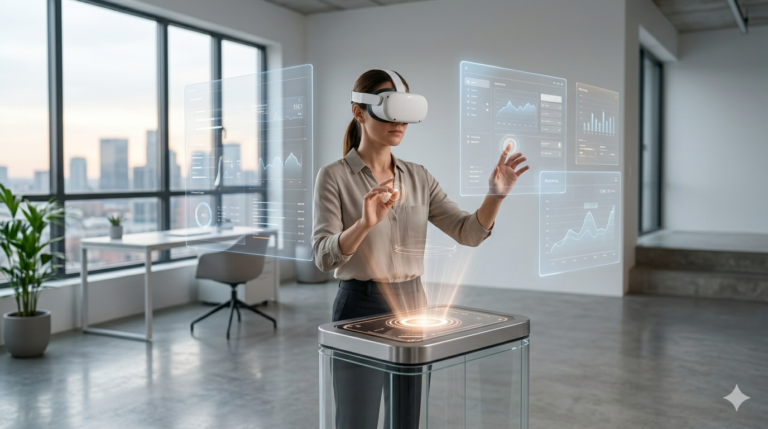
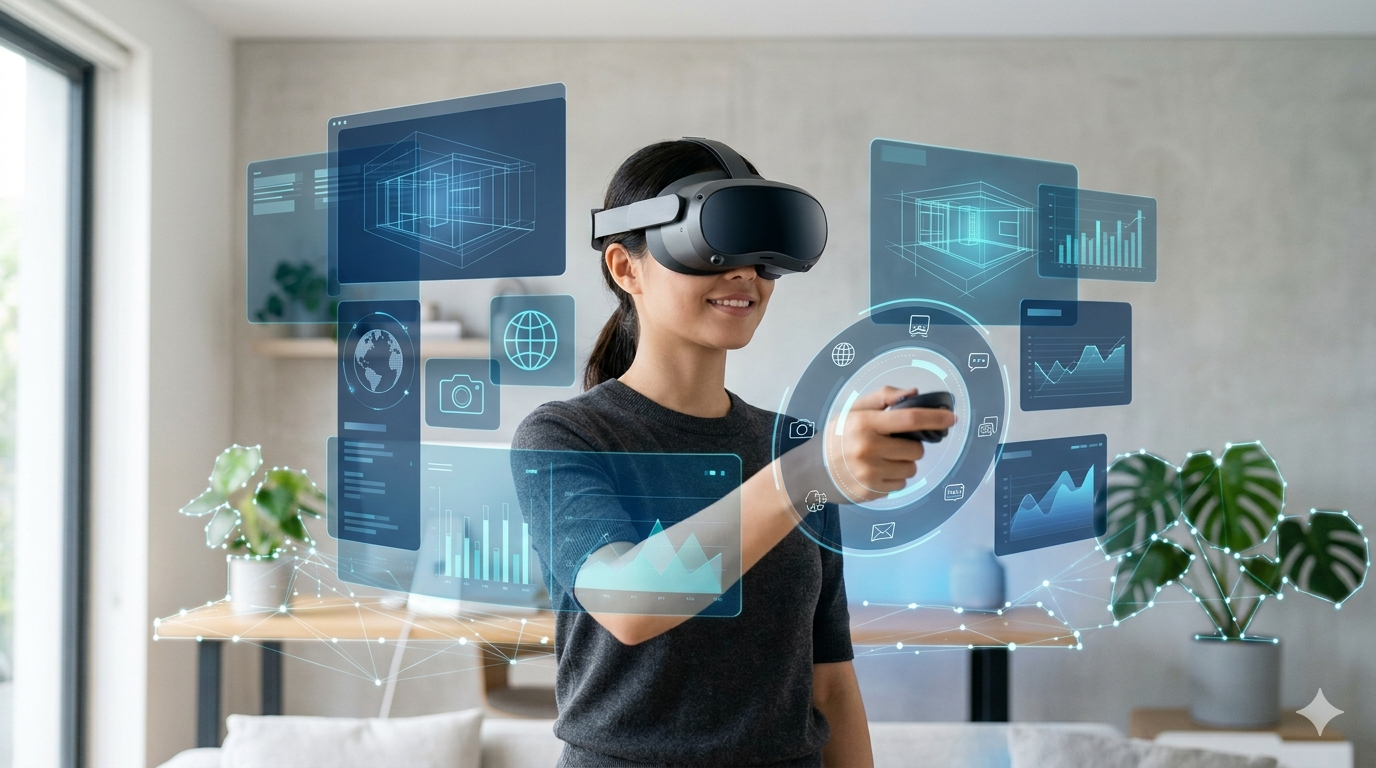
One of the clearest real-world examples of spatial reality is a workspace where digital screens stay anchored around you as you move. Instead of opening flat windows on a single monitor, users can place information in different parts of a room and treat physical space as part of the workflow.
Another strong example appears in design, training, and guided collaboration. Architects can review 3D models at meaningful scale, trainers can place instructions exactly where a learner needs them, and remote teams can discuss digital objects as if they exist inside a shared physical context.
Hardware quality also shapes how convincing those examples feel. Better passthrough, tracking, and display comfort can make spatial systems more practical, which is why it helps to compare the best VR headsets and mixed reality devices when thinking about real-world use.
How Spatial Reality Compares With VR and AR
Spatial reality overlaps with both virtual reality and augmented reality, but it is usually broader than either one term alone. VR often emphasizes full immersion in a digital environment. AR usually refers to digital overlays on top of the physical world. Spatial reality is often used to describe systems that make digital content spatially aware, whether the experience is fully immersive, blended, or somewhere in between.
That is why the term is often useful as a conceptual umbrella. It focuses less on strict labels and more on the idea that computing can understand and use space as part of the interface.
| Technology | Main Focus | Best Way to Think About It | Typical Experience |
|---|---|---|---|
| Spatial Reality Broader Concept | Space-aware digital interaction | Computing that understands physical space | Digital content placed or organized around the user |
| Virtual Reality | Full immersion | Entering a mostly digital environment | Physical world is reduced or replaced |
| Augmented Reality | Digital overlay | Adding content onto the visible real world | Real surroundings stay visible with added information |
| Mixed Reality | Blended interaction | Digital objects interact more directly with physical space | Real and digital elements feel more tightly connected |
The Best Way to Understand Spatial Reality
- Think of it as computing that uses real space as part of the interface.
- See it as broader than one device category or marketing term.
- Focus on environment awareness, stable tracking, and natural interaction.
- Judge it by whether spatial placement improves the task at hand.
- Remember that good spatial experiences depend on both hardware and software quality.
Frequently Asked Questions
What is spatial reality in simple terms?
Spatial reality is a way of using digital content that understands physical space and places apps, media, or objects around you instead of only on a flat screen.
Is spatial reality the same as virtual reality?
No. Virtual reality usually focuses on full immersion in a digital world, while spatial reality often refers more broadly to space-aware digital experiences that can include the physical environment.
How does spatial reality work?
It works through cameras, sensors, tracking, mapping, and software that understand rooms, surfaces, distance, and user movement so digital content can stay anchored in space.
What devices use spatial reality?
Mixed reality headsets, spatial computing platforms, advanced AR systems, and some immersive headsets use spatial reality concepts to place digital content within physical space.
Why does spatial reality matter?
It matters because it can make computing feel more natural and context-aware for work, learning, design, communication, and immersive entertainment.
What should readers know first about what is spatial reality?
The most important starting point is to understand how what is spatial reality works in practice, what problem it solves, and where it fits within the broader immersive technology landscape.
How does what is spatial reality? a practical guide connect to the wider XR ecosystem?
It connects through hardware, software, interaction design, and the broader move toward more immersive digital experiences across entertainment, education, and productivity.