How Haptic Feedback Works in VR Controllers and Devices
Updated 2026-04-28 by HapVR
How haptic feedback works in VR is simple at the core: software detects a digital event, then hardware turns that event into a physical cue such as vibration, pressure, resistance, or force. In VR controllers and devices, those cues are usually created by small motors, actuators, or mechanical systems that respond when you touch, grab, collide with, or move through something in a virtual environment. The result is not perfect real-world touch, but it is enough to make interaction feel clearer, more believable, and more immersive.
How haptic feedback works comes down to translation. A VR app detects an event such as touching a surface, pressing a trigger, firing a tool, or grabbing an object, and then sends instructions to hardware that can produce a physical sensation. That sensation may be a short vibration pulse, a stronger impact cue, localized fingertip pressure, or real resistance against movement.
In basic VR systems, that process happens inside handheld controllers. In more advanced setups, it can also happen through gloves, sleeves, vests, or force feedback rigs that simulate pressure and resistance more directly, which also helps answer the broader question of whether VR can simulate touch. If you want the broad foundation first, start with what haptics in virtual reality are and then compare the best VR headsets to see where different haptic approaches appear in real devices.
For technical grounding, compare Microsoft’s haptic feedback guidance, Apple’s Core Haptics documentation, and Meta Reality Labs research on haptic gloves.
Why Does Understanding How Haptic Feedback Works Matter?
Understanding how haptic feedback works helps explain why some virtual experiences feel far more convincing than others. Visuals can show a digital object, but haptics tell your body that contact actually happened. That extra signal improves timing, confidence, immersion, and task clarity.
It also matters when evaluating hardware. Some systems only confirm contact with vibration, while others simulate localized touch or active resistance. Knowing the difference helps you judge whether a device is built for casual gaming, immersive training, or research-heavy interaction.
How Does Software Trigger Haptic Feedback?
Every haptic effect starts in software. A VR game engine or simulation tracks events such as contact, collisions, recoil, movement thresholds, or successful object interaction. Once the event is detected, the system defines what kind of output should follow and how intense it should feel.
This is why good haptics are not only about strong hardware. If the feedback fires at the wrong moment or with the wrong pattern, the illusion breaks. When timing is precise, even simple hardware can make an interaction feel far more natural.
1. Software Detects a Digital Event
Every haptic response starts with software. The VR app or game detects something meaningful such as a collision, button press, recoil event, object pickup, or boundary interaction. Once the event is recognized, the system decides whether feedback should be soft, sharp, repeated, directional, or forceful.
Strengths
- Lets haptics match context instead of firing randomly
- Supports timing, intensity, and pattern control
- Connects feedback directly to user action
Limits
- Poorly designed triggers can feel artificial
- Weak software tuning limits hardware potential
How VR Controllers Create Haptic Feedback
In mainstream VR devices, haptic feedback usually comes from compact motors or actuators inside the controller body. These parts spin or pulse at controlled speeds, which creates vibration patterns that your hands interpret as contact, impact, or movement cues.
That approach is effective because the controller already sits at the point where many interactions happen. Even if the sensation is broad rather than precise, it still helps the brain connect virtual action with physical response, which is why controller haptics remain so common in consumer VR.
2. Controllers Use Motors to Create Tactile Cues
In standard VR controllers, haptic feedback usually comes from small internal motors or actuators. These parts spin, pulse, or oscillate at specific intensities to create a tactile sensation in the hands. A short pulse can suggest a button press, while a stronger vibration pattern can represent impact, recoil, or environmental contact.
Strengths
- Affordable and widely available in VR ecosystems
- Easy to understand immediately during play
- Useful for timing, navigation, and immersion
Limits
- Cannot reproduce texture or true object resistance
- Sensations are broad rather than highly precise
How Haptic Gloves and Wearables Work
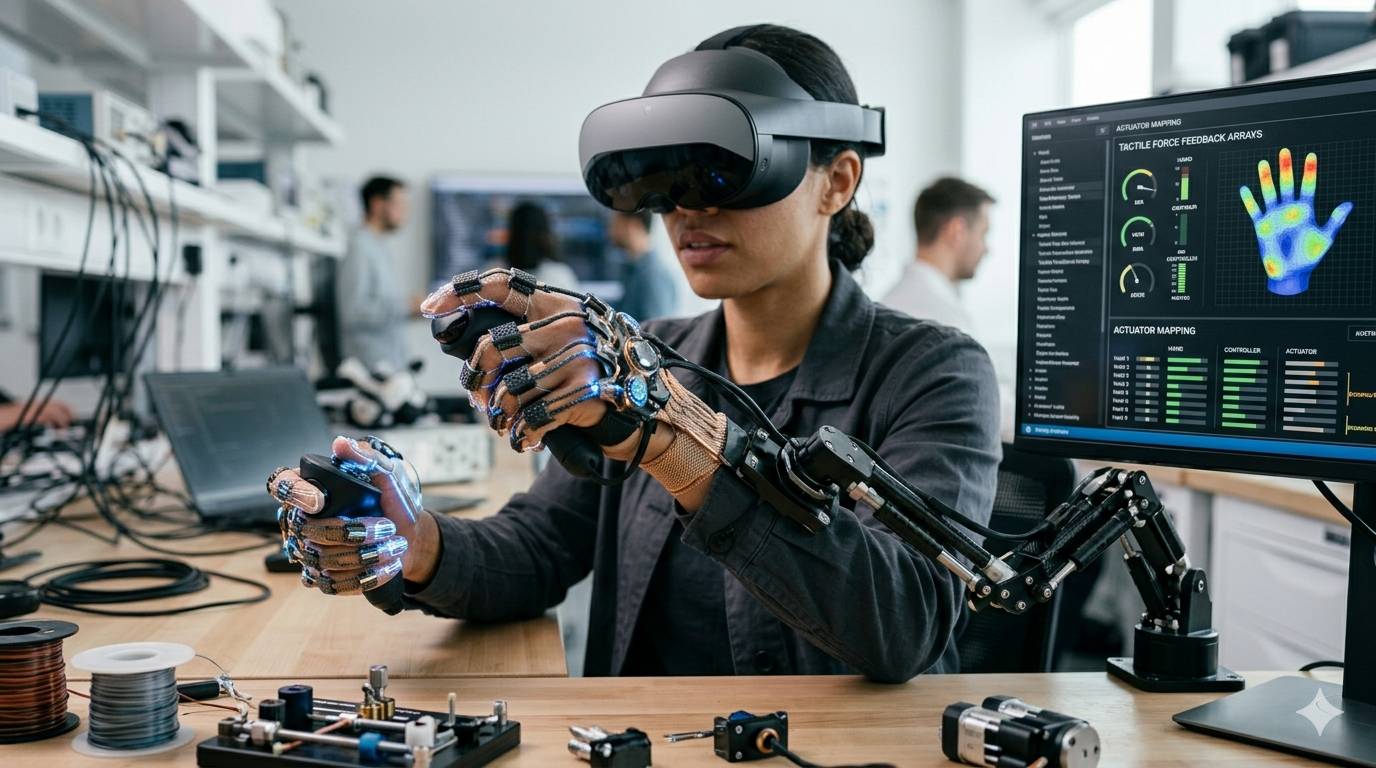
Haptic gloves and body wearables move feedback closer to where contact should feel more specific. Instead of only vibrating your palm through a controller handle, they can place feedback on fingertips, knuckles, or body zones that better match the virtual interaction.
This is where haptics begin to feel more natural for training, simulation, and research. If you compare these systems with the different types of haptic feedback, you can see how tactile signals, localized pressure, and body-based cues each solve a different interaction problem.
3. Gloves and Wearables Add Pressure and Contact Simulation
Haptic gloves and similar wearables go beyond controller vibration by placing feedback closer to the fingers and hand. These systems can use small actuators, tension systems, or localized vibration points to simulate fingertip contact, surface cues, or the feeling that your hand is meeting an object instead of passing through empty space.
Strengths
- Feels more natural for grasping and object manipulation
- Supports training and simulation better than vibration alone
- Makes hand-centered interaction more believable
Limits
- Costs more and needs more calibration
- Still limited compared with real touch complexity
How Force Feedback Systems Push Back
Force feedback systems differ from standard vibration because they resist motion instead of only signaling that contact happened. That pushback can simulate weight, recoil, drag, pressure, or tool resistance, which is especially useful when a task depends on effort and control.
This is one reason haptics matter so much in serious VR applications. When physical resistance changes how a person moves, learns, or judges force, the experience becomes more than a visual demo. It becomes a more usable training tool and a more believable interactive system.
4. Resistance Devices Push Back Against Movement
Force feedback systems work by resisting or redirecting your movement instead of only vibrating. Mechanical linkages, brakes, or powered resistance can simulate weight, recoil, pressure, or tool resistance. This is one of the strongest ways to make virtual interaction feel physically meaningful, especially in professional training or research settings.
Strengths
- Adds physical effort and resistance to virtual tasks
- Improves realism for simulation and precision work
- Helps users judge pressure and motion more accurately
Limits
- Bulkier and less practical for mainstream home use
- Usually more expensive and specialized
How Different Haptic Systems Work
Not all haptic systems solve the same problem. Some are built for accessibility and speed, while others are built for realism and precision. That is why it helps to compare how each category creates feedback and what kind of task it serves best.
| System Type | How It Creates Feedback | Best Use | Main Limitation |
|---|---|---|---|
| VR controllers Most Common | Motors create vibration and pulses | Gaming and mainstream VR interaction | Limited realism |
| Haptic gloves | Actuators and tension create hand contact cues | Natural hand interaction and training | Higher cost and setup complexity |
| Wearable vests or sleeves | Embedded actuators create body impact cues | Immersive gaming and simulation | Less precise than fingertip systems |
| Force feedback rigs | Mechanical resistance pushes back on movement | Professional simulation and research | Specialized hardware |
How to Think About Haptic Feedback in VR
- Start with the software event, because bad trigger design makes even strong hardware feel weak.
- Treat controller vibration as the entry point, not the full definition of haptics.
- Expect gloves and force systems to matter most where realism, training, or precision is important.
- Use device comparisons to separate tactile confirmation from true resistance and force.
- Remember that the best haptics support the task instead of distracting from it.
Frequently Asked Questions
How haptic feedback works in VR controllers?
VR controllers use small motors or actuators that pulse or vibrate when software detects an event such as impact, button presses, recoil, or object contact.
What triggers haptic feedback in virtual reality?
Haptic feedback is triggered by software events such as collisions, grabbing objects, pressing buttons, weapon recoil, movement cues, or scripted interaction signals.
Do haptic gloves work the same way as controllers?
Not exactly. Controllers mainly rely on broad vibration, while haptic gloves can add localized fingertip cues, pressure, or resistance closer to direct hand interaction.
What is the difference between vibration and force feedback?
Vibration gives tactile confirmation, while force feedback pushes back against your movement to simulate resistance, weight, recoil, or pressure.
Why does haptic feedback make VR feel more real?
It makes VR feel more real because physical cues reinforce what your eyes see, helping your brain connect digital action with bodily sensation.
Can haptic feedback simulate texture in VR?
Some advanced systems can suggest texture cues, but most consumer VR haptics still focus more on impact, timing, vibration, and basic contact than true texture reproduction.
Where is advanced haptic feedback most useful?
Advanced haptic feedback is most useful in training, simulation, research, healthcare, engineering, and other tasks where realistic touch improves performance.
Is haptic feedback only used in gaming?
No. Gaming is the most visible example, but haptics are also used in education, product design, medical simulation, industrial training, and immersive research.